Training · Kickoff Gathering 2026
More Than What Your Group Produces
The world hands you your identity last. God starts there, and it changes how you lead
In high school I got named captain of my soccer team. Youngest captain they’d ever had. When you’re a young captain you think the title does something for you, that the armband comes with credibility built into it. They voted for me, so now they trust me.
About two weeks in I was frustrated, because every time I opened my mouth nobody wanted to hear it. I was giving guys feedback I thought was helpful, stuff about how we could play better, and all I got back were side eyes.
So I went to my coach and asked him how to say something to my teammates without it landing as a put down.
He said something I’ve never forgotten. If all you ever do is tell them what they have to fix, they’ll never listen to you.
That one stuck, because he was right and I knew it. I hadn’t done anything to actually know those guys. I’d never told a single one of them what I saw in him. Their strengths, what I respected about them, who they were as teammates and as people. All I’d ever handed them was corrections.
People can feel the difference between somebody who only points out what’s wrong with them and somebody who actually sees them.
I think about that every time I watch a leader start sizing up their group.

The moment you start doing math
You know the moment I mean. A few weeks in, you look around your living room and you start taking inventory. Is this a good group or not? Are these good members or not? And if we’re being real about it, it gets personal fast. Am I doing a good job here, or a bad one, based on what I’m seeing in front of me?
That instinct doesn’t make you a bad leader. It makes you a normal one. It’s an incredibly natural way to think.
I just don’t think it’s how God thinks.
Five circles
Picture five circles nested inside each other.
The outer one is your environment. Where you are, who’s around you, Hoboken or Jersey City. Inside that is your behavior, your habits, what you actually do on a given day. Inside that, your capabilities, the things you’re good at. Maybe you ask great questions. Maybe you carry a lot of empathy for people. Inside that, your beliefs, what you hold to be true and what matters to you. And at the center, your identity. Who you are.
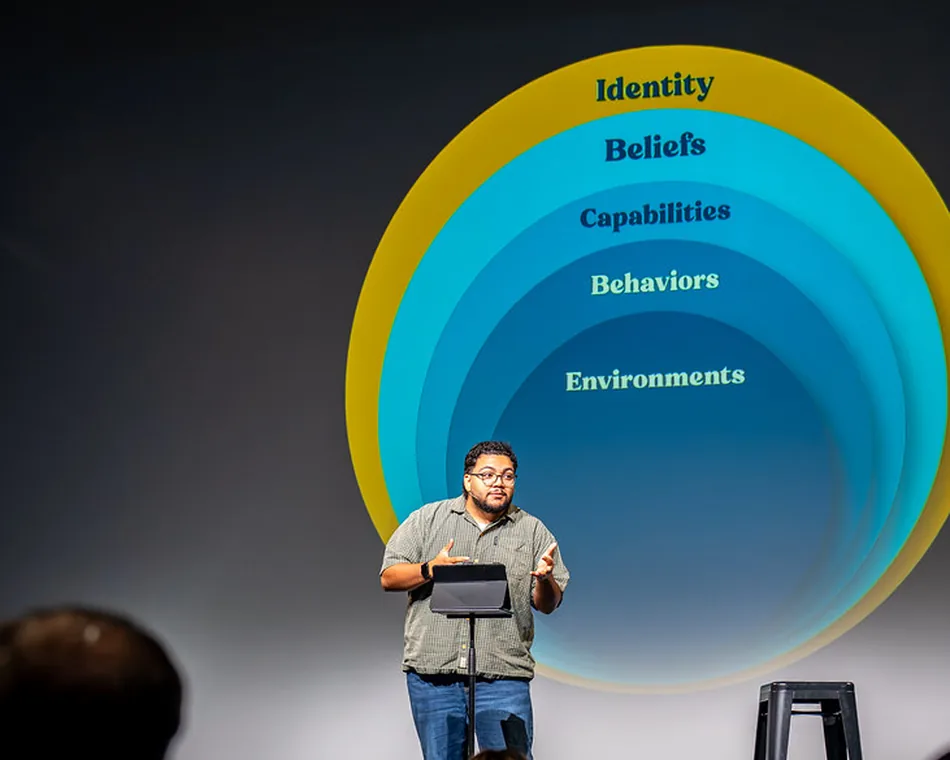
The world reads that from the outside in.
It looks at your environment first. What do you have, how many people are in this group, what does your apartment look like, what do you do for work, what neighborhood are you in. Then it moves to your behavior. What do you do, how do you act, are you disciplined or are you a mess. Then your capabilities. Are you good at this, are you talented, are you impressive in a room.
And only after all of that does the world get around to asking who you actually are. What, what, what, and then way down at the end, who.
That’s the order the world hands you your identity in. You are what you have, what you do, and what you’re good at, and somewhere at the bottom of the list you find out who you are. It’s also why hiding comes so easily. The world only ever asks about the first three, so we shield the last two. The people in your group are doing that right now.
God does the exact opposite.
He starts with who. Before anything else, before a single behavior has changed, before you’ve proven one capability, he speaks to your identity and tells you who you are to him. Loved. Chosen. His. Only after that does he work outward. Your beliefs start to shift because you know who you are, and out of that your capabilities and your behavior and even your environment start to look different. Not because you were trying to earn an identity, but because you already had one and it’s producing something in you.
Who, then what. Not what, then who.
Zacchaeus in the tree
Luke 19 is the clearest picture of this anywhere in Scripture.
Zacchaeus was a tax collector, and not just any tax collector. He was a chief tax collector, which meant he was wealthy and everybody knew he was taking money from people. In that world that made him an outcast. So when Jesus comes through Jericho and a crowd gathers, everyone there already has Zacchaeus figured out. They know exactly what he does and they know exactly what kind of person that makes him. In their minds that’s the whole story.
He’s short, so he can’t see over the crowd. He runs ahead and climbs a sycamore tree just to catch a glimpse. For a wealthy chief tax collector, running and climbing a tree is beneath him, which tells you how badly he wanted to see this man. He didn’t have words for what he was after.
That’s how a lot of people are going to walk into your group this year. They won’t have words for the community they’re craving. What they’re actually craving is Jesus, and belonging.
And when Jesus gets to that tree, he stops and looks up.
Zacchaeus, come down; I must stay at your house today.
Luke 19:5
Zacchaeus hasn’t confessed anything. He hasn’t apologized, he hasn’t promised to pay anybody back, he hasn’t changed a single behavior. Jesus doesn’t lead with “I know what you’ve done and here’s what you have to fix.” He invites himself into this man’s life, publicly, in front of the exact crowd that had already decided who Zacchaeus was.
They grumble about it, because Jesus is going to eat with a sinner. And then something happens in Zacchaeus. Right there, in response to being seen and welcomed before he’d done one thing to earn it, he says he’ll give half of everything he owns to the poor and pay back four times over anybody he’s cheated.
Look at the order. Jesus doesn’t wait for the behavior to change and then hand Zacchaeus his identity back. He speaks the identity first, you belong, you’re one of God’s own, and the behavior comes flooding out after it.
So what does that do to you
You are more than what your dinner group produces this year.
God isn’t waiting to see how your group turns out before he tells you who you are. He already told you. You’re his, loved by him and chosen by him, whether this is the best group you’ve ever led or the hardest one. Your identity was never up for a vote based on how the season goes.
When you let that be true, when you stop striving to make something happen and let yourself be reminded that God loves you no matter the state of your group, something starts to move out of you toward the people in front of you. You’re not carrying the pressure of trying really hard to do really well, because you’re not performing for anybody. Not even for God. And out of that rest you get to actually love the people in your group through whatever they’re walking through. Not to prove anything. That’s just what it looks like to already be living in love and to let it move toward somebody else.
You can’t change the people in your group. You can remind them who they are.
And you don’t do it alone
Paul tells the Philippians not to be anxious about anything, but in every situation, by prayer and petition, with thanksgiving, to bring their requests to God.
That’s a “we” instruction. We get to bring ourselves to God together. Bless the people around the circle. Say out loud what’s heavy and what you want to hand over. Lean into listening. Follow the nudges when they come.
My coach was right about the side eyes. What he didn’t tell me, because he didn’t know it, is that the reason you don’t lead with corrections isn’t that corrections are rude. It’s that somebody already told those guys who they were, a long time before I got the armband, and my job was never to argue with it.
Neither is yours.
Discussion questions
Use these with your group, your apprentice, or in your next huddle.
- Which of the five circles do you tend to lead from, and which one do you tend to measure yourself by?
- Think of somebody in your group. What have you seen in them that you’ve never said out loud to them?
- Where are you waiting on your group to produce something before you feel settled about your own leadership?